
STP Plant: 7 Proven Ways to Reuse Treated Water
Monsoon’s done for the year. Reservoirs look fine, borewells have come back up, and the tanker calls have stopped. So nobody’s thinking about water. That’s the problem.
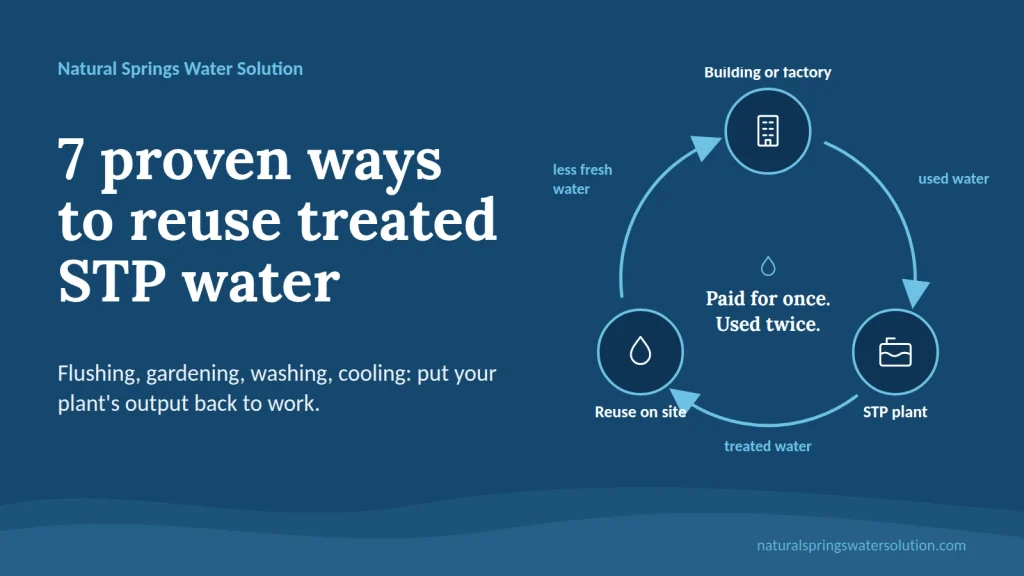
Think about what happens at most buildings and factories every single day. Fresh water comes in, and it costs money. Used water goes straight down the drain, thousands of litres of it. An STP plant closes that gap. It cleans the used water right on your premises and you put it back to work. Flushing, gardening, washing, cooling. Your fresh supply barely gets touched.
Below you’ll find how an STP plant works, seven ways to reuse what comes out of it, the Maharashtra rules worth knowing, and the mistakes that sink reuse projects. We’re Natural Springs Water Solution, in Dombivli East, so the examples lean local.
Why the Rain Pattern Is Changing Your Water Math
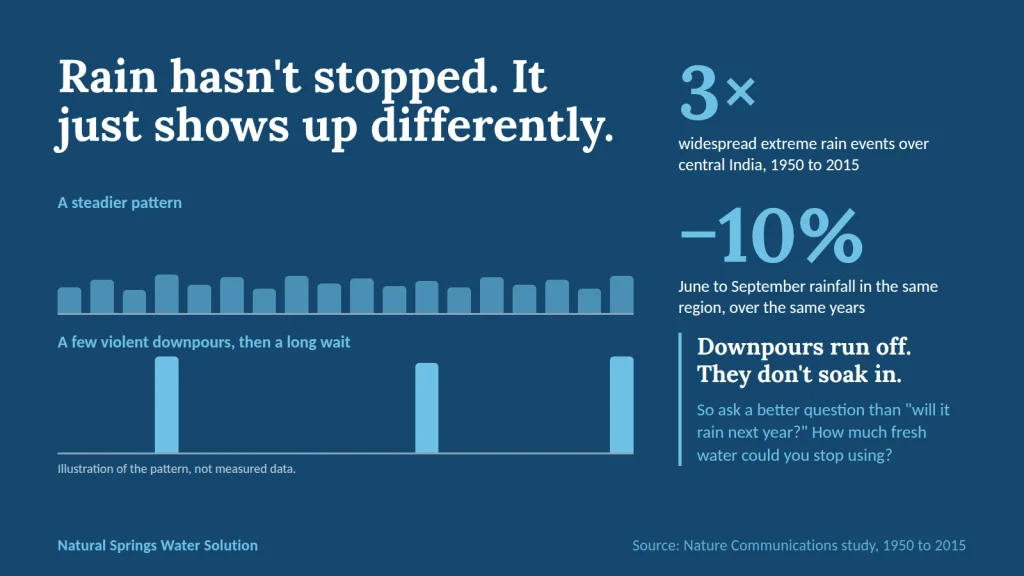
Rain hasn’t stopped. It just shows up differently now.
One study in Nature Communications looked at 1950 to 2015 and found that widespread extreme rain events over central India had tripled. Over the same years, June to September rainfall in that region fell by about 10 percent. By the study’s definition, central India stretches from the Gujarat and Maharashtra coast across to Odisha, so you’re standing in it.
Stanford researchers came at the problem from another side, using decades of India Meteorological Department data. Their finding was wetter wet spells and more frequent dry spells. A few violent downpours, then a long wait. Violent downpours run off. They don’t soak in, and groundwater doesn’t thank you for them.
Then there’s El Niño. WMO says it’s close to certain to last into February 2027, and we wrote up what that means around Mumbai and Thane in our post on water scarcity in India.
So here’s a better question than “will it rain next year?” How much fresh water could you stop using? Reuse is the cleanest answer, because the water is already on your site. You paid for it once. Why pay again?
What an STP Plant Actually Does
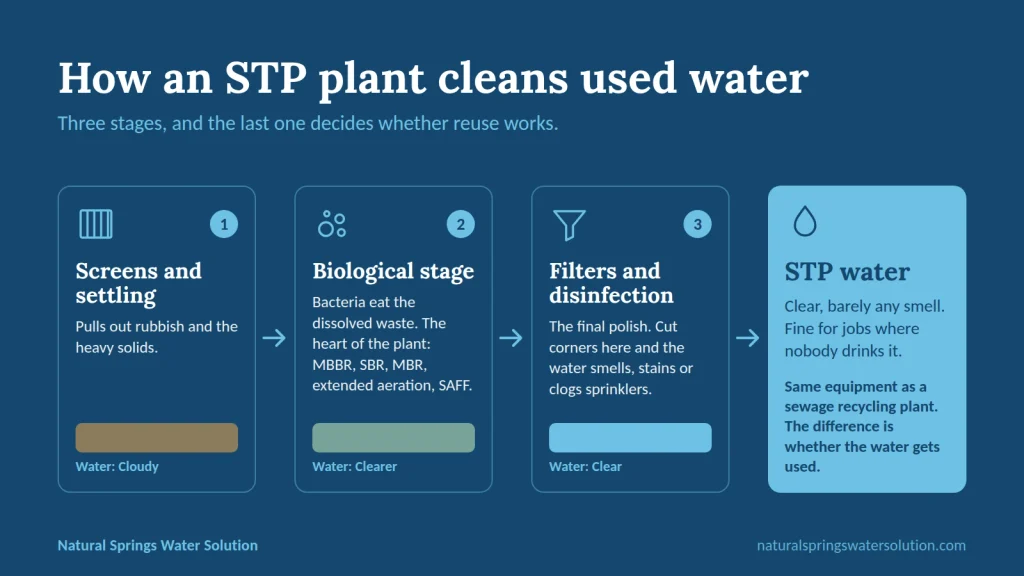
An STP plant, short for sewage treatment plant, takes the used water from bathrooms, kitchens and laundry and cleans it. Clean enough to discharge, or clean enough to reuse. It gets there in three stages.
First, screens and settling tanks pull out the rubbish and the heavy solids. Next comes the biological stage, where bacteria eat the dissolved waste. That’s the heart of the plant and it’s where the technologies split: MBBR, SBR, MBR, extended aeration, SAFF. Same job, different way of doing it. Last, filters and disinfection polish the water.
What comes out is STP water. Clear, barely any smell, fine for jobs where nobody drinks it. Maharashtra’s 2025 reuse policy recommends secondary-treated water for non-potable uses and says tertiary-treated water can be made fit for drinking. That second bit is a city-level decision. A housing society shouldn’t go near it.
You’ll also hear the term sewage recycling plant. Same equipment. The only real difference is whether the treated water actually gets used or just gets dumped.
Each technology is explained on our services page if you want the detail. One thing to take from here: reuse lives or dies on that last polishing stage. Cut corners there and the water smells, stains, or clogs your sprinklers.
7 Proven Ways to Reuse STP Water
Not every use needs the same quality, so we’ve ordered these from easiest to fussiest.
- Toilet flushing
A large percentage of the daily water in an apartment building is used for flushing, and none of it must be fit for human consumption. Pipework is the hitch. In order for treated water to reach the cisterns and nothing else, it requires a separate network known as dual plumbing.
It’s simple to build that while the tower rises. Retrofitting after the fact is terrible. Double plumbing for flushing is necessary for larger projects in Maharashtra, which means that before making any assumptions, review your approved plan.
- Gardening and landscaping
The easy one. Plants don’t care where the water came from. Drip lines and sprinklers run happily on STP water if the filtration is decent, since suspended particles are what block emitters. Gardening is on the list of urban uses in Maharashtra’s 2025 policy.
- Washing vehicles, floors and driveways
Car washing, parking decks, lobby floors, the hose-down after a festival. Cleaning gets through far more water than people expect. And if your society still washes cars with tanker water while an STP plant hums away in the basement, that’s money going down the drain, quite literally. The policy names vehicle washing too.
- Cooling towers and HVAC make-up water
Malls, hospitals, office towers and factories lose a lot of water to evaporation in cooling towers. STP water can top that up, usually after extra polishing. Your cooling-water vendor will want a quality report first, so ask for one. It protects the chillers, too.
- Firefighting reserve tanks
Fire tanks sit full all year. Topping them up with fresh water is a waste when treated water will do. Firefighting is on Maharashtra’s list of recommended uses, though your fire consultant should still sign off on how it’s connected.
- Construction
Curing, mixing, dust control. A builder with a project next to a working STP plant can use treated water on site and skip a few tanker trips. Construction is on the policy’s list as well.
- Industrial reuse, with an ETP and STP plant together
Most factories need both. The STP deals with canteen and toilet sewage. The ETP deals with process effluent. Together, an ETP and STP plant can return a good amount of water to cooling, washing and landscaping, and after RO polishing, some of it can go back into the process.
Sitting in an MIDC estate? Watch the policy. It asks MIDC to consult industrial units about setting up treatment plants and buying treated wastewater from nearby municipal bodies, and it puts thermal power plants and industries first in line as buyers.

Matching Supply to Demand
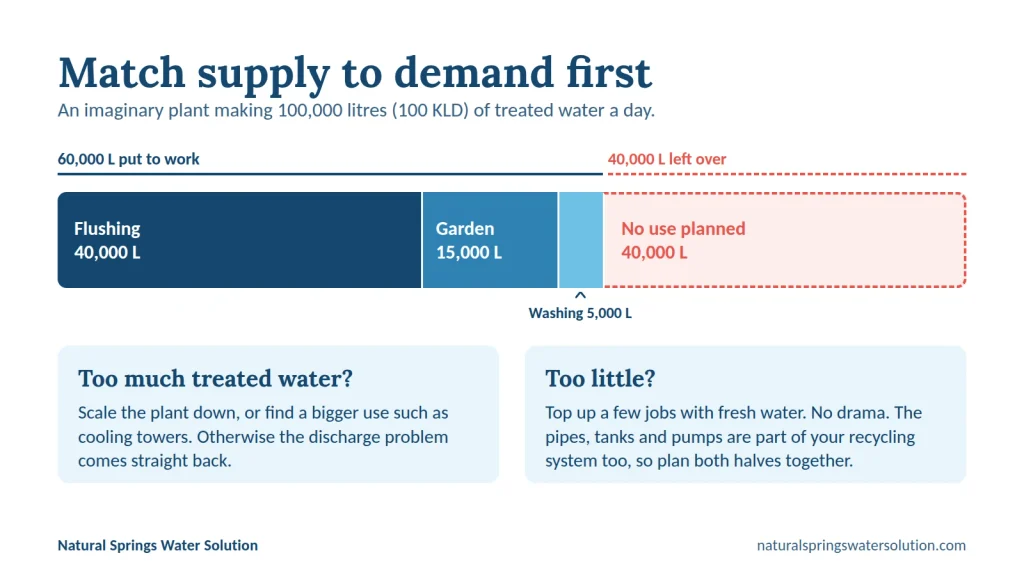
Before you commit, do one sum. Add up what you’d use for flushing, gardening, washing and cooling. Then compare it with what your STP plant will produce each day.
To show why, consider this imaginary case. Let’s say the facility provides you with 100,000 litres of treated water every day. It takes 40,000 to flush. The garden requires 15,000. An additional 5,000 are needed for washing. With 40,000 litres left with somewhere to go, the discharge issue again. Reduce the scale of the plant or find a larger use, such as cooling.
The opposite case is easy. If the plant makes less than you can use, top up with fresh water for a few jobs. No drama. Everything that carries treated water to those uses, meaning the pipes, tanks and pumps, is your water recycling system. The STP plant is only the first half of it. Plan both halves together.
What Maharashtra’s Rules Say About Treated Water Reuse
Let’s keep this plain.
I read that on October 7 2025 the Maharashtra cabinet adopted the Safe Reuse and Management of Treated Wastewater Policy. With ₹500 crore behind it the policy requires 424 local bodies to handle and manage sewage. When treated water is available the policy says it should first go to power plants then to industry then to non-potable urban applications and finally to irrigation, in that order.
This policy expands upon actions. I see that the policy states that least thirty percent of water must be reused in urban local bodies according to the Maharashtra State Water Policy, 2019. The National Water Policy, 2012 views recycling and reuse as the standard and the National Mission for Clean Ganga released a National Framework for Safe Reuse of Treated Water in 2022.
News reports on the policy of 2025 say that it could push housing societies and industrial estates toward using treated water, for gardening, flushing vehicle washing and firefighting. I read that as the direction of travel. I will confirm the final rules with my planning authority.
Does your building need an STP plant at all? If it’s big, probably yes. Under the EIA Notification 2006, projects with 20,000 sq m or more of built-up area need Environmental Clearance, and an on-site STP is a standard condition. Local building rules can set lower thresholds.
After that the Maharashtra Pollution Control Board sets treated‑water quality. This is done through Consent to Establish and Consent to Operate. For some large projects, MPCB consents have required 80 percent of the treated sewage to be recycled. We handle that paperwork with the equipment, which saves a lot of chasing.
What an STP Plant Costs and How It Pays Back
Anyone quoting a fixed price without seeing your site is guessing. So what actually moves the number?
Capacity, mainly. Plants are sized in KLD (kilolitres a day), and more daily sewage means bigger tanks, blowers and pumps. Technology matters too. A compact MBBR plant and an MBR plant with membranes don’t cost the same. Then comes civil work: digging, tank walls, a blower room. And finally polishing. Water going to a cooling tower needs more treatment than water going to a flower bed.
Don’t forget the second bill. The water recycling system needs its own treated-water tank, pumps and pipework, and in an old building that plumbing can be a bigger job than anyone expects.
Payback comes from fresh water you no longer buy. Tanker water tends to get pricier when everyone’s short, which is exactly when reuse earns its keep. And if your building needs an STP plant anyway, you’re really just deciding whether to use the output. Using it is where the savings are.
Mistakes That Make Reuse Fail
Most failed reuse projects trip over the same handful of things.
The big one is that nobody ever plans the reuse. The STP plant runs, the paperwork’s happy, and treated water quietly goes to the drain. A water recycling system only works if the treated water reaches something. Otherwise you’ve built a very expensive way to get rid of water.
Storage trips people up next. Treated water comes out in a steady trickle, but demand arrives in bursts. With no buffer tank, the output has nowhere to go during quiet hours.
Then there’s polishing. Cloudy or smelly water kills trust fast. Residents complain, someone switches the dual plumbing back to fresh water, and that’s the end of reuse.
An STP plant also needs looking after. It’s alive, in a way. Bacteria want air, steady feed and attention, and without an AMC or a trained operator the quality drifts. Nobody notices until the neighbours mention the smell.
Test the outlet water regularly and keep the reports. Regulators can ask for them. A buyer can too, if you ever sell treated water on.
Last one, and it’s about safety. STP water never goes anywhere near drinking taps. Label every treated-water pipe and valve, clearly and permanently.
STP Plant in Dombivli, Thane, Navi Mumbai and Mumbai
We’re in Dombivli East, Thane district, so site visits across Dombivli, Kalyan, Thane, Navi Mumbai and Mumbai are quick. Looking for an STP plant in Dombivli, an STP plant in Thane for a housing society, an STP plant in Navi Mumbai or Mumbai, or an ETP and STP plant for a factory in an MIDC estate? That’s home ground for us.
We create, construct and maintain STP, ETP, RO, WTP, ZLD and rainwater harvesting systems from wastewater recycling for housing societies to an ETP plant for a factory in Maharashtra. Reuse and rainwater harvesting work together so we design them as one system and your fresh water use reduces from both ends. If you also need MPCB Consent to Establish or Consent to Operate we take care of that along, with the equipment.
We install and support plants further out too: Ahmedabad, Chennai, Hyderabad, New Delhi, Vadodara. Wherever the site is, we start in the same place. Real water use. Real space. Real end uses. Then we design the sewage recycling plant around those, not around a template.
Frequently Asked Questions
What does an STP plant do for water reuse?
It cleans used water from bathrooms, kitchens and laundry so that the same water can be used again. A sewage treatment plant, sometimes called a sewage recycling plant transforms that water into a kind of water that can flush toilets, irrigate gardens wash vehicles and refill cooling towers. This means we need to buy fresh water.
I see an STP plant sometimes called a sewage recycling plant turning water into something that can toilets, irrigate gardens wash vehicles and top up cooling towers.
Less fresh water to buy.
Is STP water safe to drink?
No. STP water is meant for non-drinking uses. Maharashtra’s 2025 policy recommends secondary-treated water for non-potable uses and says tertiary-treated water can be made fit for drinking, but that’s a city-scale project. A building shouldn’t attempt it.
Does Maharashtra require an STP plant?
For large projects, usually yes. Anything that has 20,000 meters or more of built-up area must get Environmental Clearance under the EIA Notification 2006. An, on-site STP is a requirement.. Local building rules might set a lower threshold so check with your planning authority.
Where can treated STP water be used?
Flushing, gardening, washing vehicles and floors, cooling tower make-up water, fire tanks and construction are the common ones. Factories can use it for cooling and washing too, and sometimes in the process itself after RO polishing.
How is an STP plant different from an ETP?
An STP plant handles sewage from toilets, kitchens and laundry. An ETP handles industrial process effluent, which changes from industry to industry. Plenty of factories run an ETP and STP plant side by side.
Can a factory reuse its own ETP water?
Often, yes. Treated ETP water can go to cooling, washing and landscaping, and some can return to the process after RO polishing. What’s allowed depends on the effluent and on your MPCB consent conditions.