
STP Capacity Calculation for Apartments: 5 Easy Steps
A tailor measures the cloth before he stitches. He doesn’t eyeball it and hope. Your society’s sewage treatment plant deserves the same treatment, because an STP’s size should come from measuring too.
Why bother? Because a wrong size costs you both ways. Too small, and the plant overloads. Sewage backs up, the smell reaches the lobby, and the treated water slips past the limits in your consent. Too big, and you’ve paid for tanks, blowers and pumps that spend their lives half idle.
So this guide walks through the STP capacity calculation in five steps, using a 100-flat society as the running example. You’ll see how to calculate STP capacity for your own building, what KLD means, why peak load gets its own check, and what to ask your consultant. We’re Natural Springs Water Solution, in Dombivli East, and this is the sum we do for societies all the time.
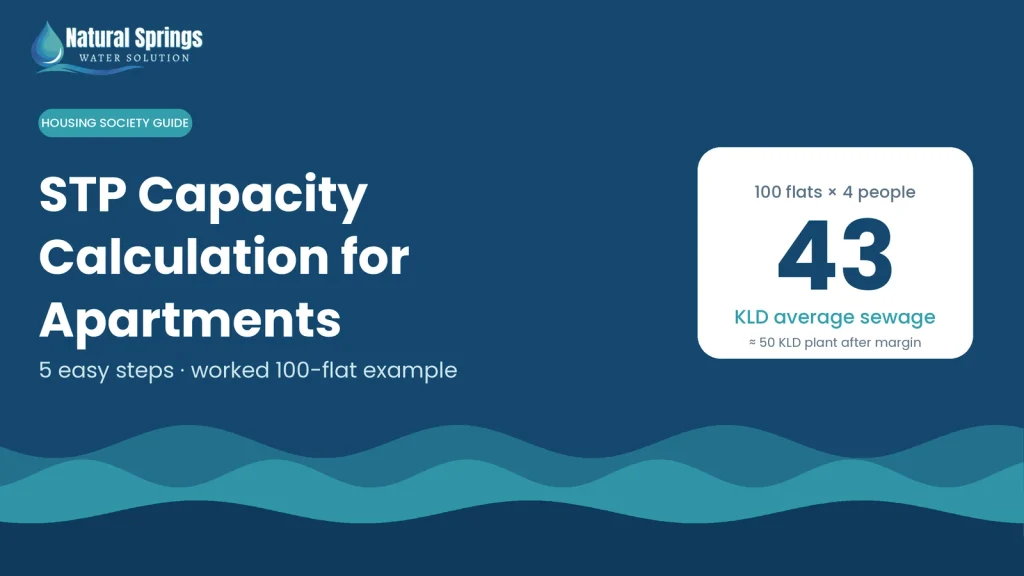
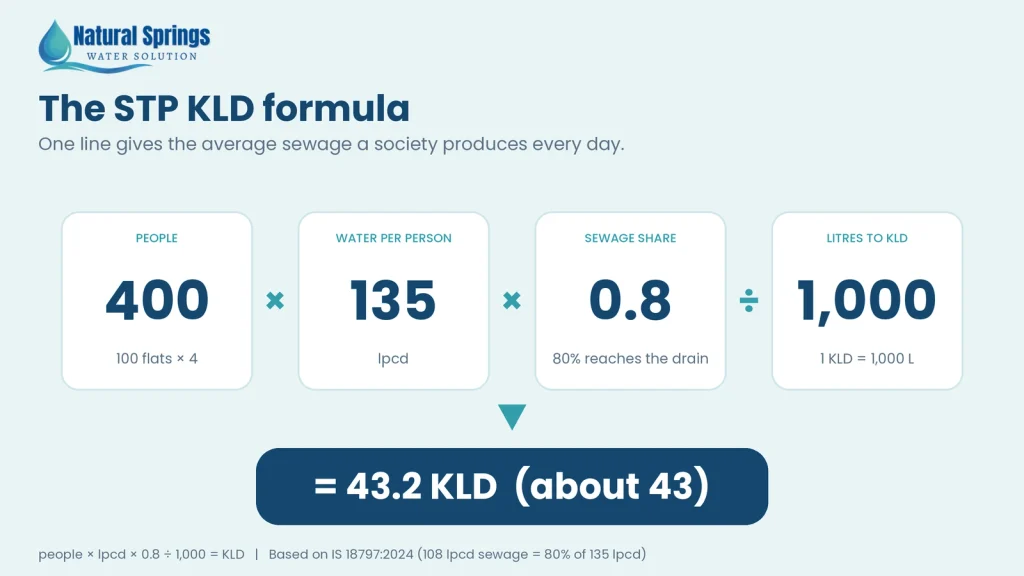
The short answer: STP capacity in KLD = people × 135 litres × 0.8 ÷ 1,000. For 100 flats with 4 people each, that’s about 43 KLD. The rest of this STP capacity calculation guide explains where each number comes from.
What Is KLD, and Why Is an STP Sized in It?
What is KLD? Kilolitres per day. A kilolitre is 1,000 litres, so 1 KLD is 1,000 litres a day, or one cubic metre. If someone says your society needs a 45 KLD plant, they mean one that treats about 45,000 litres of sewage a day.
Every quote, drawing and consent application hangs off that number. So the STP capacity calculation boils down to one job: finding your society’s KLD honestly. Here’s how to calculate STP capacity, one step at a time.
What You Need Before an STP Capacity Calculation
Before you open a calculator, round up five bits of information. How many flats, and what mix of 1, 2 and 3 BHKs. How many people live there now, or will when the building fills. The water supply per person in lpcd. Any extras, like a clubhouse, a pool or guest rooms. And how fast the society will fill, since one that takes three years to reach full occupancy needs a different plant from one that’s full in six months.
Have all five and the STP capacity calculation takes ten minutes. Miss one and everything after it is a guess in a nice font.
Step 1: Count the People
Flats don’t flush toilets. People do. So an STP capacity calculation starts with a headcount, and the flat count is just how you get there.
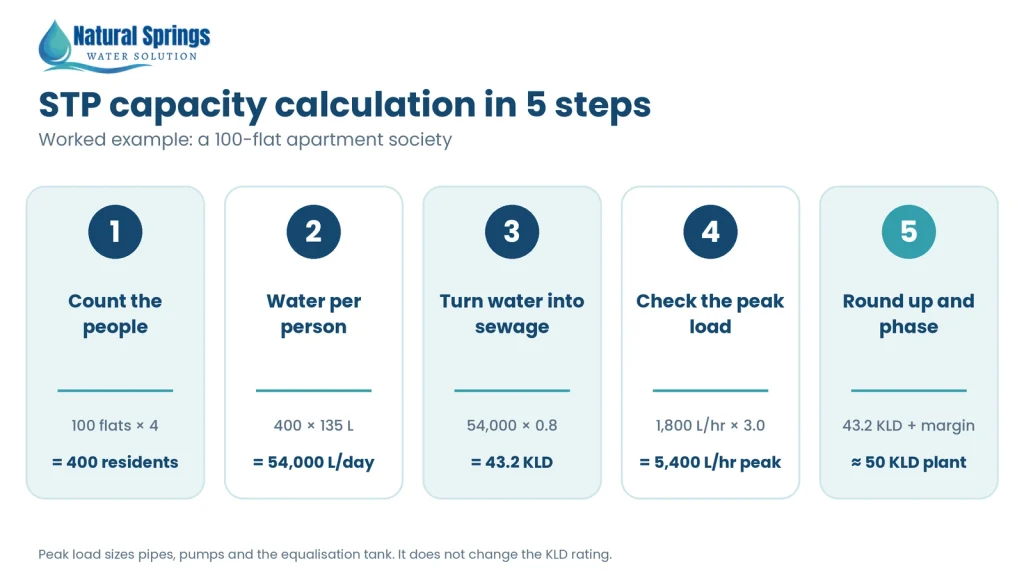
Our example: 100 flats, 4 people each, 400 people.
Four is a common number people use when planning. Designers often pick four or five. Some people go room by room instead. They might say two people for a one bedroom hall kitchen three for a two bedroom hall kitchen and about four and a half for a three bedroom hall kitchen. Whatever number you decide on write it down. A place with flats might think four is too low. A place, with lots of one bedroom hall kitchens might think four is too high.
Step 2: How Much Water Does Each Person Use?
This is water consumption per person per day, written as lpcd, litres per capita per day. For homes, 135 lpcd is the number most Indian designers start from. CPHEEO, the central public health engineering body, quotes 135 to 150 litres a day for residential use. The BIS standard for packaged sewage treatment plants, IS 18797:2024, works from a 135 lpcd water supply too. Every STP capacity calculation leans on this figure, so use the right one.
Run the numbers: 400 people × 135 litres = 54,000 litres a day.
About 45 of those 135 litres usually go on flushing. Keep that in your head. It matters later, when you work out how much treated water you can reuse, and we dig into that in our guide to STP plant water reuse.
Step 3: Turn Water Into Sewage
Not every litre you use ends up in the drain. Some evaporates. Some goes on the plants. Some gets cooked into dal or simply drunk. Designers therefore treat about 80 percent of water use as sewage.
BIS says the same in IS 18797:2024: sewage is generally considered 108 lpcd, which is 80 percent of a 135 lpcd supply. That’s your sewage generation per person per day.
For our example, 54,000 × 0.8 = 43,200 litres a day. Divide by 1,000 and you get 43.2 KLD. Call it 43.
Put it in one line and you have the whole STP capacity calculation formula: people × lpcd × 0.8 ÷ 1,000 = KLD.
STP capacity calculation at a glance
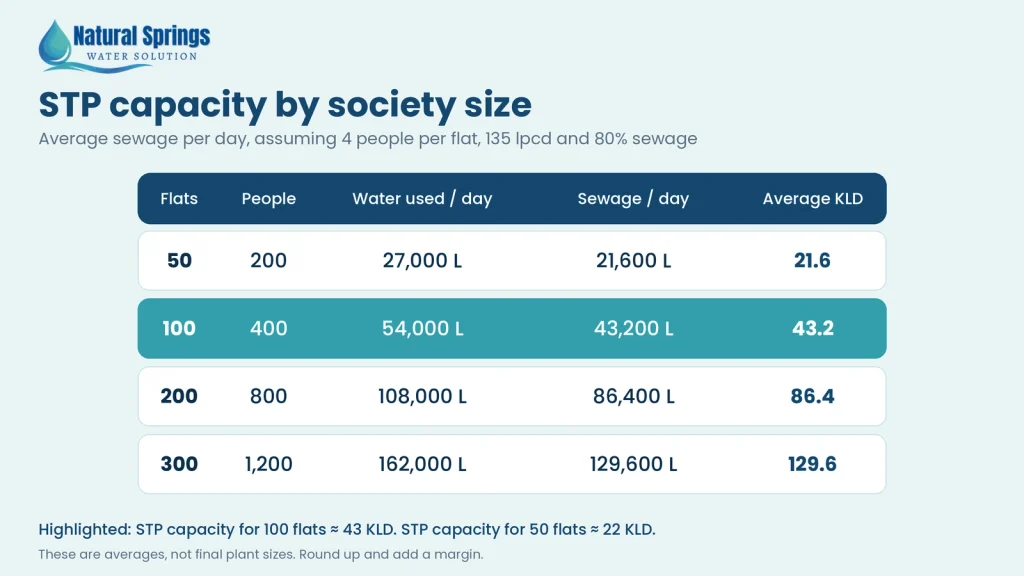
Same STP capacity calculation, other society sizes, assuming 4 people a flat, 135 lpcd and 80 percent sewage:
| Flats | People | Water used per day | Sewage per day | Average KLD |
|---|---|---|---|---|
| 50 | 200 | 27,000 litres | 21,600 litres | 21.6 |
| 100 | 400 | 54,000 litres | 43,200 litres | 43.2 |
| 200 | 800 | 108,000 litres | 86,400 litres | 86.4 |
| 300 | 1,200 | 162,000 litres | 129,600 litres | 129.6 |
So the STP capacity for 100 flats is about 43 KLD, and for 50 flats about 22 KLD. These are averages. They aren’t plant sizes yet.
Step 4: Check the Peak Load on Its Own
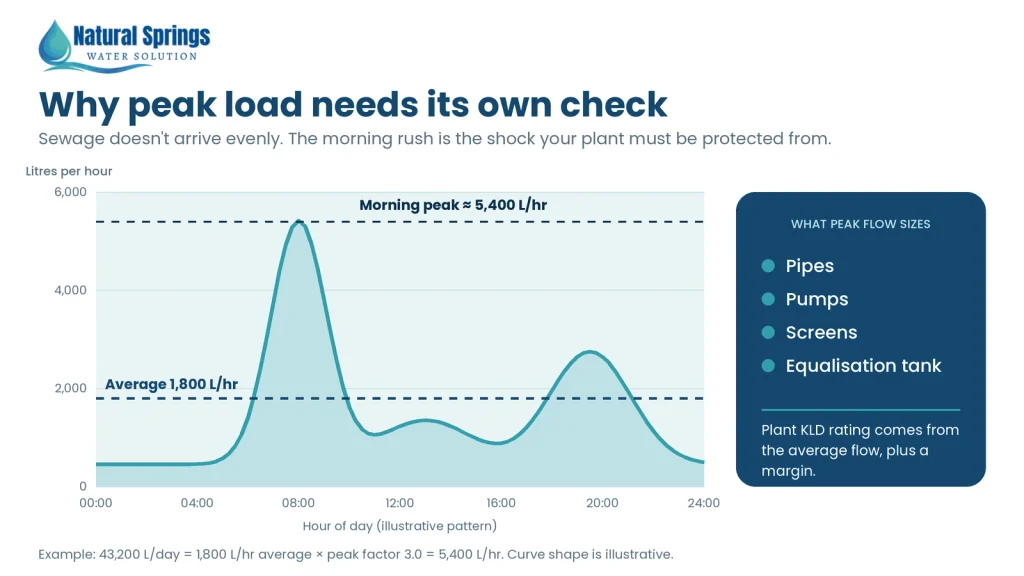
Here is where people slip. KLD is a total but sewage does not flow in a smooth stream. Think of 7 to 9 in the morning when 400 people are showering, flushing and starting the washing machine together. Now think of 2 in the afternoon when the pipes are nearly silent. Every sewage treatment plant in apartments lives with this rhythm.
Peak flow gets its check and a proper STP capacity calculation always includes it. Take the hourly flow and multiply by a peak factor. In our example 43,200 litres a day is 1,800 litres per hour on average. CPHEEO recommends a peak factor of 3.0 for populations up to 20,000 and small populations swing hardest because there are people to smooth things out. At 3.0 the peak comes to 5,400 litres per hour.
What does that number mean? It refers to the pipes, pumps, screens and the equalisation tank. It does not change the KLD rating of the plant. A good designer sizes the biology for the average and lets an equalisation tank soak up the morning rush so the plant meets a steady flow instead of a shock.
One caveat. CPHEEO wrote those peak factors for sewer design and the right factor also depends on things, like how many hours of water supply the building gets. Your designer should pick the factor for your site not copy one from a table.
Step 5: Round Up, Add a Margin, Plan for Phasing
The STP capacity calculation has handed you 43.2 KLD. Please don’t order a 43.2 KLD plant.
Plants come in standard sizes, so you round up. Many designers add a margin as well, for growth, extra guests, a leaking flush valve, or a morning rush worse than the table predicted. In our example, something like a 50 KLD plant would be a typical outcome, though your designer’s margin and the technology you pick will shape the final figure.
Then think about move-in. New societies fill slowly. If only 40 of the 100 flats are occupied in year one a single 50 KLD plant runs at a fraction of its design load and the bacteria struggle. Modular or phased plants can match capacity to occupancy so ask about that early. Treat your STP capacity calculation as a starting point then revisit it as people move in.
How to Calculate STP Capacity for an Occupied Building
If people already live there, you can stop guessing. Pull a few months of meter readings, work out the daily average, and take about 80 percent as sewage. Then compare with the norm. Meter says 120 litres a head and the norm says 135? You’ll see it straight away. That’s how to calculate STP capacity when real data exists, and real data beats a table.
Two warnings. Don’t rely on one month, since holidays and festivals skew it. And make sure the meter covers the whole society, with no borewell or tanker supply feeding a few wings on the side. Missing water means missing sewage, and your STP capacity calculation comes out too small.
Mistakes That Wreck an STP Capacity Calculation
A handful of errors show up again and again.
The first is counting flats instead of people. Two societies with 100 flats can have very different populations, and the STP capacity calculation should follow the people. Then there’s the clubhouse. Gym showers, pool backwash and guest rooms all add sewage, and leaving them out means the plant starts life overloaded.
Some people multiply the KLD by the peak factor, which is the one that costs real money. Peak factor is meant for pipes, pumps and the equalisation tank. Apply it to the daily capacity as well and you risk buying a plant much bigger than the society needs.
Copying a neighbour’s number is another. Their flats, their lpcd, their occupancy. A sewage treatment plant in apartments next door tells you very little about yours. And ignoring move-in speed finishes the list. A plant sized for full occupancy on day one runs badly for years if people trickle in.
Any STP for housing society projects should be checked against these five before anyone signs a quote.
What Goes Wrong When the Size Is Wrong
Too small to begin with. An overloaded plant can’t handle it. Sewage spends little time in the biological tank the treated water doesn’t meet the quality standards the smell starts to come out and your consent conditions begin to seem uncertain. Fixing this later means adding tanks or starting over which costs much more, than getting the STP capacity calculation right the first time.
Too big is quieter but still expensive. You pay more upfront, you may run bigger blowers and pumps than you need, and a badly under-loaded plant can’t keep its bacteria healthy, so water quality can suffer anyway.
A right-sized plant is gloriously boring. It runs, it passes its tests, and nobody mentions sewage at the annual general meeting.
Does Your Society Use More Than 135 Litres?
Maybe. 135 Liters per capita per day is a planning norm, not a rule of nature. Some buildings use water and big-city designs often go up to 150. A society with a pool a clubhouse or lots of visitors will use more. Others use less after installing low-flow taps and toilets.
So add the extras one by one. A clubhouse, a gym with showers a guest flat a car-wash bay. Each should have its line, in the STP capacity calculation. Don’t just add an extra percentage. Then take 80 percent of the total as sewage unless your designer has a reason to use a different return factor.
From KLD to the Right Technology
Once your STP capacity calculation gives you a KLD, technology is the next question. MBBR, SBR, MBR, extended aeration and SAFF all treat sewage, but they differ in footprint, power use, tolerance for flow swings and the quality of the treated water. For an STP for housing society use, space and the end use of that water usually decide it. Our services page explains each one.
The KLD also tells you how much treated water you’ll have every day. A 43 KLD sewage flow means close to 43,000 litres of treated water to put to work. If you haven’t decided what that water will do, read the reuse guide before you finalise anything. A sewage treatment plant in apartments is only half the job. Using what comes out is the other half.
STP for Housing Societies in Mumbai, Thane, Dombivli and Navi Mumbai
Societies in the area keep asking us one question than anything else: how big should our STP be? We are located in Dombivli East so visiting sites is easy across Mumbai, Thane, Dombivli, Kalyan and Navi Mumbai.
Perhaps you need an STP for a housing society in Mumbai, an STP for a housing society in Thane, an STP for apartments in Dombivli or an STP for a housing society in Navi Mumbai. No matter where you are we start with the STP capacity calculation mentioned above then compare it with your water bills or building plans. As an STP manufacturer in Thane district we create, build, install and maintain the plant ourselves. An STP for housing society projects anywhere in Maharashtra uses the STP capacity calculation even though local authority rules can add their own conditions.
Hiring an STP consultant in Mumbai? Ask to see the calculation in writing with every assumption listed: people per lpcd return factor, peak factor. If one is missing ask why.
Here is our offer. Send us the number of flats the mix of bedrooms and recent water bills and we will calculate your societys KLD for free. We provide STP, ETP, RO, WTP, ZLD and rainwater harvesting. We also handle MPCB consent paperwork along, with the equipment.
Frequently Asked Questions
What does KLD mean in an STP?
KLD stands for kilolitres per day. One KLD equals one thousand litres per day which’s also one cubic metre. KLD tells how sewage an STP can treat each day. Therefore a 50 KLD plant can treat up to fifty thousand litres per day. KLD is the result of every STP capacity calculation.
How do you calculate STP capacity for one hundred flats?
Assume one hundred flats, each with four residents giving four hundred residents in total. If each resident uses one hundred thirty‑five litres per day the total water consumption is fifty‑four thousand litres per day. Eighty percent of this water turns into sewage, which equals forty‑three thousand two hundred litres or about forty‑three KLD. Round that number up. Add a safety margin to determine the plant size.
How much sewage does a single person produce each day?
One hundred eight litres, which is eighty percent of a 135 litre per person, per day water supply. This figure is used by BIS in IS 18797:2024. Actual numbers vary depending on the building the fixtures and the residents.
Is 135 lpcd the right figure for apartments in Mumbai?
It’s the usual starting point, and CPHEEO quotes 135 to 150 litres for residential use. Large-city designs sometimes lean toward the higher end. Ask your designer which figure they’re using and why, then check it against your actual water bills.
Who should do the STP capacity calculation?
Your STP designer or consultant, and they should show their working. The sum is simple enough for a committee to check. If the numbers on a quote don’t follow the people, lpcd and 80 percent logic above, ask why before you sign.
Does peak load change the size of the STP?
Not the KLD rating. Peak flow decides how big the pipes, pumps, screens and equalisation tank need to be, because those parts handle the morning surge. The plant’s daily capacity comes from the average flow in your STP capacity calculation, plus a margin.
Can I use my water bill instead of the standard figure?
For an occupied building, often yes, and it’s usually the better choice. Take a few months of meter readings, work out the daily average, and take about 80 percent as sewage. Real consumption beats a planning norm, as long as the building is close to full.
Want your society’s KLD worked out properly? Send your flat count, bedroom mix and water bills to Natural Springs Water Solution. Contact our team and we’ll run the STP capacity calculation for free.